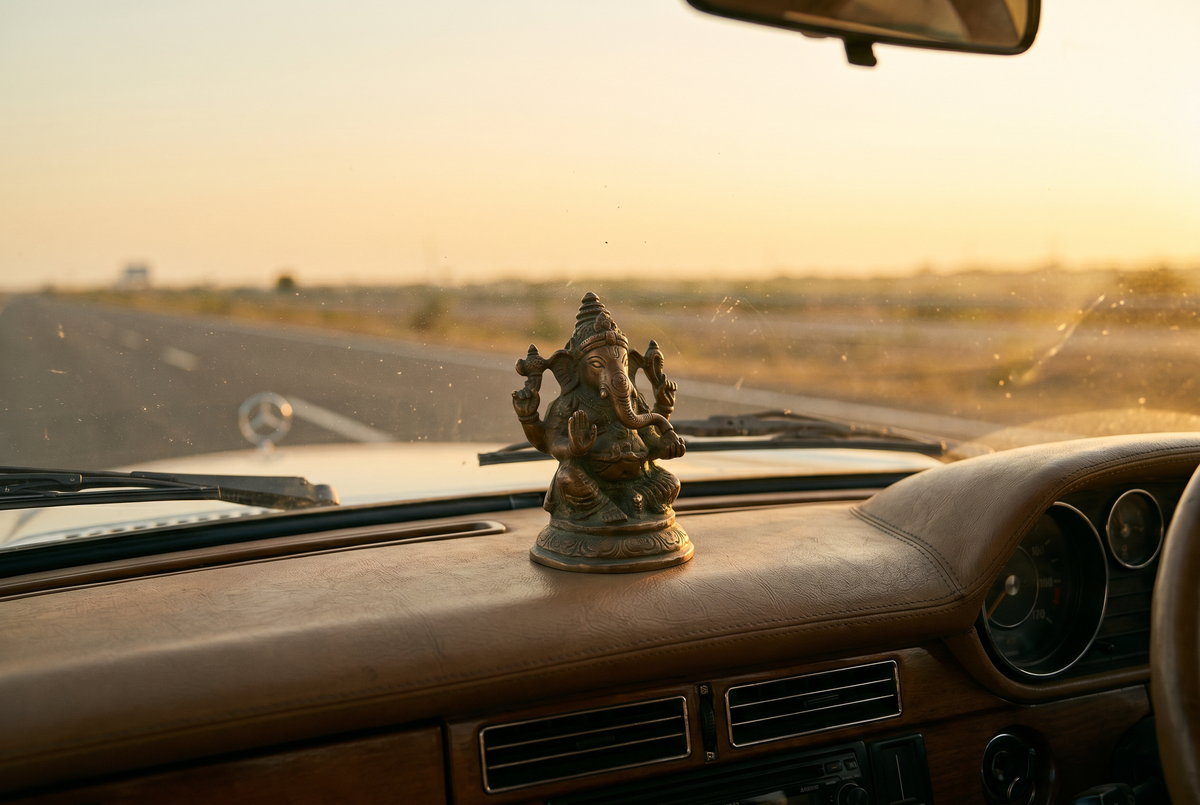
Which Idol Is Right for Your Car Dashboard?
Indian drivers have always put something on the dashboard. A small piece, sometimes a coin or a photograph, more often a small token of a figure from the tradition. It is one of the quietest, most consistent cultural habits in the country. Walk past any taxi rank in any city in India and the dashboards will be lived-in: stickers, garlands, small figures, all chosen carefully and kept close.
This guide is for anyone choosing what to keep on their own dashboard.
Which idol is right for your car dashboard?
The right piece for your car dashboard is one that is small enough to sit safely on the dash, heavy enough not to slide on rough roads, finished well enough to survive heat and dust, and meaningful enough to want to look at every day. Cultural fit comes first, build quality comes second, aesthetic comes third.
For most Indian drivers, the default answer has been Ganesha. The remover of obstacles, the one asked for a safe journey, the figure most commonly placed on the dashboard for decades. Ganesha is the default for a reason: the cultural fit is direct, the story is universal, the small-figure form translates well to a dashboard scale.
This guide takes the default question seriously, examines why it became the default, and presents one alternative worth knowing about for drivers who want something different on their dashboard.
Why Ganesha is the default
Ganesha is called Vighnaharta, the remover of obstacles. In the Hindu tradition, no important journey, no new venture, no first day of anything begins without remembering Ganesha. The cultural logic is direct: a car is a vehicle that takes you through traffic, weather, distance, and uncertainty. A small Ganesha on the dashboard is a reminder that someone has your back on the road.
There is also a practical reason. Ganesha is one of the few figures from the tradition whose form translates well to a small, seated, single-piece sculpture. The proportions work at dashboard scale. The face is recognisable even at three inches. The pose is stable on a flat surface. Generations of small Ganesha pieces, made in brass, in resin, in painted plaster, have sat on Indian dashboards for as long as cars have been on Indian roads.
The result is that almost every dashboard piece sold in India today is a Ganesha. Mass-produced plastic models for under two hundred rupees, brass pieces for a few thousand, hand-finished pieces in resin or stone for the higher end. The selection is wide, the market is mature, the default is set.

Why Adiyogi is the alternative worth knowing about
Adiyogi means "the first yogi." In the Hindu tradition, Adiyogi is Shiva in his role as the original teacher, the one who first transmitted yoga to the human race. The form most people picture today comes from the 112-foot Adiyogi bust at the Isha Yoga Center in Coimbatore: the meditative seated bust, the inward gaze, the long matted hair, the quiet third eye at rest.
An Adiyogi on the dashboard does something different from a Ganesha. Ganesha says "may the road be clear." Adiyogi says "let the road be what it is, and let you be what you are." The cultural register shifts from intervention to stillness. The figure is not asking for anything on your behalf, the figure is the form of a teacher at rest, a presence rather than a request.
For drivers who spend long hours on the road, who think of driving as a meditative act, who want something on their dashboard that asks for a quieter relationship with the journey, Adiyogi is the alternative worth knowing. It does not replace Ganesha. It offers a different reading of what a dashboard piece is for.
What makes a piece dashboard-ready
Three things separate a dashboard-ready piece from a piece that just happens to be small.
Size and proportion. A dashboard piece sits within the driver's peripheral vision. Anything larger than four inches in any dimension starts to encroach on the road view, anything smaller than two-and-a-half inches loses presence. The sweet spot for most cars is a three-inch piece with a base under three inches wide. The Adiyogi Bust by Ikon 3-inch is built specifically to this dimension.
Weight and stability. The dashboard sees vibration, sudden braking, rough roads, monsoon throws. A piece needs enough weight to stay put without needing tape or putty, and a flat or near-flat base wider than the piece is tall. Soft adhesive pads should not be a requirement for stability.
Finish that survives. The dashboard sees direct sunlight for hours, summer cabin temperatures that climb past 60°C in Indian conditions, dust, cleaning sprays. A piece needs a finish that can take heat without warping, sun without fading, and an occasional wipe-down without losing detail. Mass-produced plastic pieces fail this test within months, well-made resin and brass pieces hold up for years.

Where to place the piece on your dashboard
Centre-left of the dashboard, just below the windshield line, on the driver's natural line of sight when relaxed. Not so far left that it shifts into the driver's primary road view. Not so far right that the passenger blocks it during conversation. Not on the cluster directly in front of the steering wheel, that is the road instrument zone and must stay clear.
If your dashboard is textured or sloped, a small flat anti-slip mat under the piece (1.5 to 2 inches wider than the base on all sides) keeps the piece level and stable. Premium dashboard pieces ship with a matched mount disc designed for this. The Adiyogi Bust by Ikon 3-inch comes with a Saikou mount disc that twist-locks to the base.
Are there vastu rules for dashboard pieces?
There is no scriptural source that prescribes vastu rules specifically for car dashboards. Cars did not exist when vastu texts were written. What does exist is a small cluster of contemporary suggestions adapted from broader vastu principles: face the piece toward the driver rather than away, keep it slightly elevated relative to the gear shift, do not place it directly above the engine. None of these are firmly grounded in primary vastu literature. Treat them as preferences, not rules.
What matters more for any thoughtful dashboard piece is that the piece is one the driver actually wants to look at every day, that the piece is well made, and that the piece is placed where it does not block the road view.
How to tell a good dashboard piece from a cheap one
The market for dashboard pieces in India runs from a hundred rupees to thirty thousand. Three things separate a piece worth keeping from a piece worth replacing in six months.
Material honesty. Plastic pieces are sometimes sold as resin, brass-coloured pieces are often plated, "marble" pieces are usually marble dust in a polymer binder. None of these are inherently wrong, they are just not what they claim to be. A piece worth keeping is honest about what it is made of.
Craft hands, not factory volume. A piece moulded once and reproduced ten thousand times by machine has no character in the small details. A piece sculpted carefully and finished by hand, even in an edition of a thousand, carries the gesture of the person who finished it. The price difference reflects the labour.
A studio with a name. Pieces from anonymous suppliers are interchangeable. Pieces from a studio with a name, a place, and a stated standard of work carry the weight of that studio's reputation. If you cannot find out who made the piece, the piece is probably not worth keeping.
The Adiyogi Bust by Ikon 3-inch, for your dashboard

We made the Adiyogi Bust by Ikon 3-inch version specifically for the Indian car dashboard. The form is the meditative bust established at the 112-foot original at Isha. The finish is hand-painted, sealed for heat and sun. The base sits at 2.2 inches wide. The piece ships with a Saikou mount disc that twist-locks to the base, so the piece stays level on dashboards of any contour.
Saikou is an Indian design studio. We build collector-grade cultural art from the epics, legends, history, and cinema that shaped India. The Adiyogi Bust is a limited edition of one thousand at the 3-inch scale, numbered, signed, with a Certificate of Authenticity in the box. It was the first piece in our Ikon line, and it was the right piece to begin with for exactly the dashboard use case this guide describes.
The piece is not a substitute for Ganesha. It is the option worth knowing about for drivers who want something quieter on their dashboard, made well, by people who actually care.